
Gemstone reference
Birthstones
by month.
Birthstones offer a personal starting point for custom jewelry. Some months have one widely recognized stone, while others offer several choices with very different colors, properties, and care requirements.
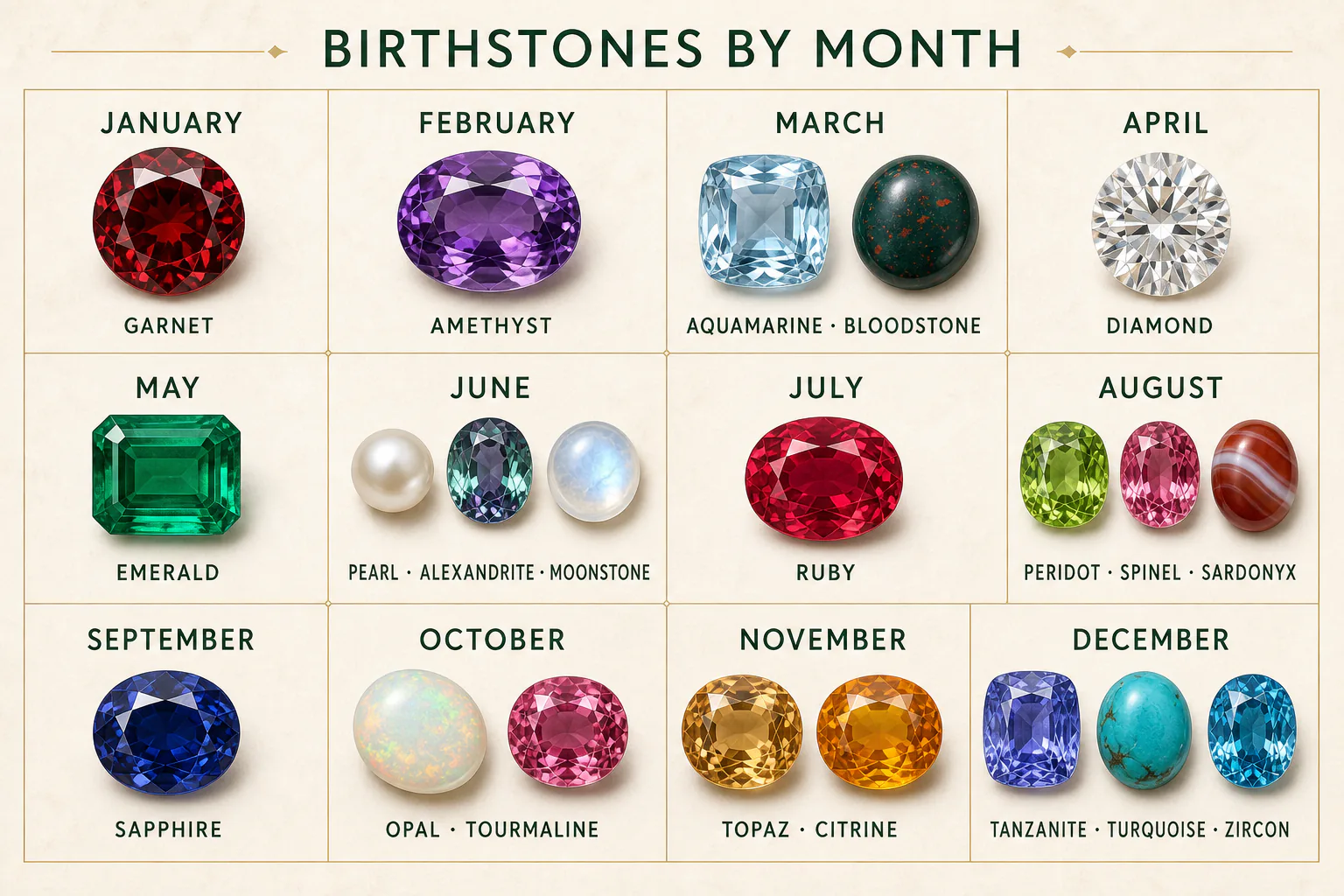
January through December
Find the month.
Choose the stone.
The colors below are visual cues rather than grading references. Gemstones can occur in broader color ranges, and natural variation means each stone should be selected from its actual specifications.
January
Garnet
Best known for deep red, although the garnet family occurs in many colors.
February
Amethyst
The purple variety of quartz, ranging from pale lilac to deep violet.
March
Aquamarine · Bloodstone
Blue to greenish-blue aquamarine, or dark-green bloodstone with red markings.
April
Diamond
Known for exceptional hardness and brilliance; available colorless or in fancy colors.
May
Emerald
The green variety of beryl, valued across a range of green hues.
June
Pearl · Alexandrite · Moonstone
Three distinct choices: organic pearl, color-changing alexandrite, or glowing moonstone.
July
Ruby
The red variety of corundum, from pinkish red to deeper red hues.
August
Peridot · Spinel · Sardonyx
Green peridot, many-colored spinel, or layered sardonyx offer varied design directions.
September
Sapphire
Famous in blue, while fancy-color sapphires occur in almost every color except red.
October
Opal · Tourmaline
Opal may show play-of-color; tourmaline offers one of the widest gemstone color ranges.
November
Topaz · Citrine
Topaz occurs in many colors; citrine is yellow to orange quartz.
December
Tanzanite · Turquoise · Zircon
Three choices commonly associated with blue, blue-green, or violet-blue tones.
Before production
Specify more than
the birth month.
The right stone for a keepsake necklace may not be the right stone for a ring worn every day. Review the complete use case before approving the design.
Confirm the exact stone
A month may have several accepted birthstones. Record the selected material, color, shape, size, and origin before production.
Design for daily wear
Hardness, toughness, cleavage, porosity, and exposure to impact affect whether a stone suits a ring, pendant, earring, or bracelet.
Disclose treatments
Heat, irradiation, oiling, dye, coating, stabilization, and other treatments may require disclosure and can affect care instructions.
Match the setting
Protect vulnerable corners and surfaces, allow suitable cleaning access, and select a metal color that supports the intended gemstone appearance.
Birthstone reference: GIA’s birthstones for each month. Gemstone color, durability, treatments, care requirements, and suitability should be confirmed for each selected stone.