
Earring style reference
Earring
styles.
A broad comparison of 30 recognizable earring designs—from close-fitting studs and diamond hoops to moving drops, chandeliers, and traditional jhumkas.
Start with the silhouette
How the earring sits and moves.
An earring style describes its relationship to the ear: whether it rests on the lobe, follows its curve, surrounds open space, or hangs below the piercing.
Names can overlap. A hoop can be a huggie, a stud can include a halo, and a drop can also be described as a dangle when its components are articulated.
Visual reference
Thirty styles,
three clear views.
The styles are separated into close-fitting designs, diamond hoops and curved forms, and longer drop or statement earrings so each silhouette remains easy to compare.
Studs & close-fitting styles
Compact designs that sit on, behind, or follow the earlobe.
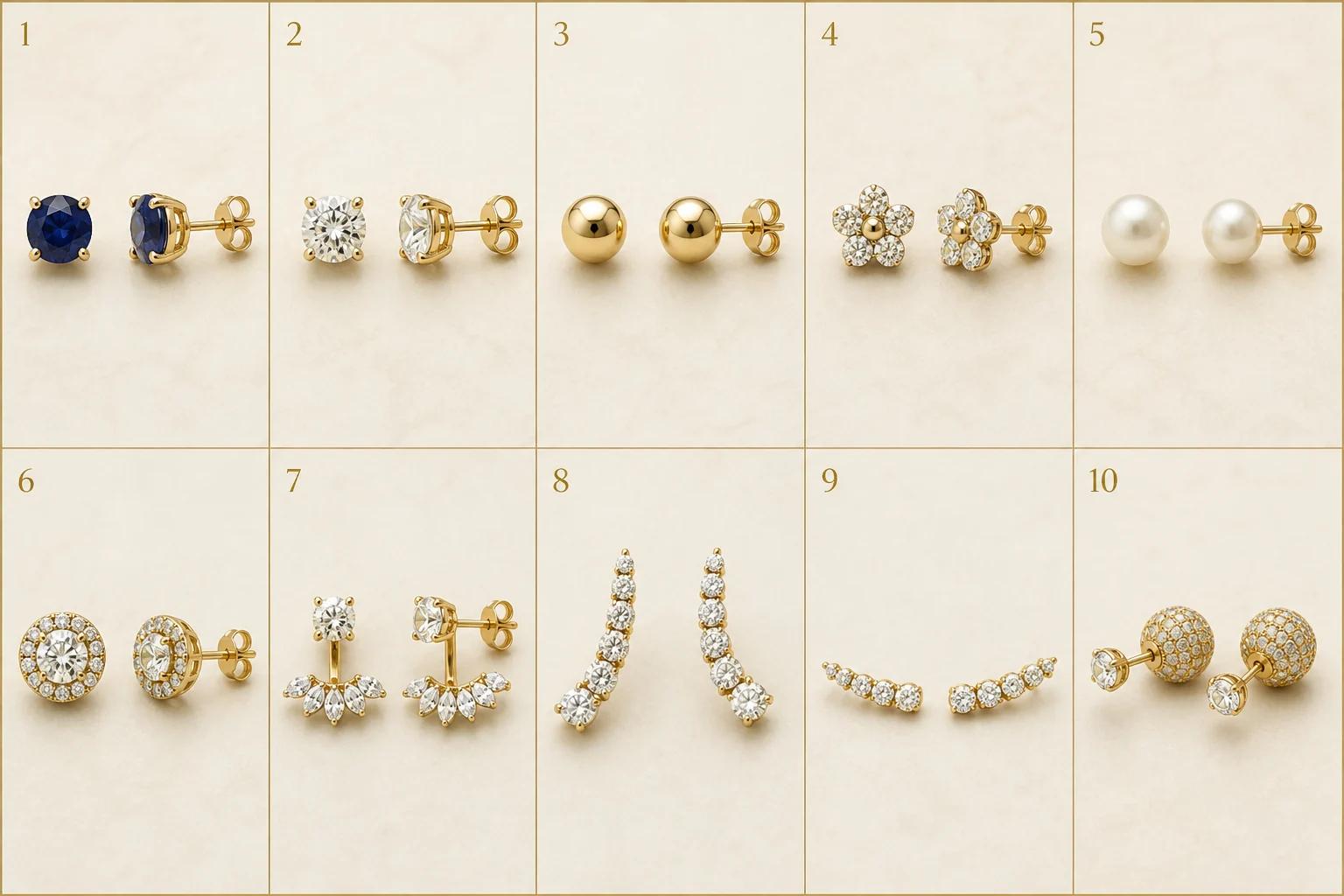
- 01Gemstone stud
- 02Diamond solitaire stud
- 03Ball stud
- 04Flower stud
- 05Pearl stud
- 06Halo stud
- 07Ear jacket
- 08Ear climber
- 09Ear crawler
- 10Front-back stud
Diamond hoops & curved styles
Circular, geometric, and ear-wrapping forms with diamond detailing.
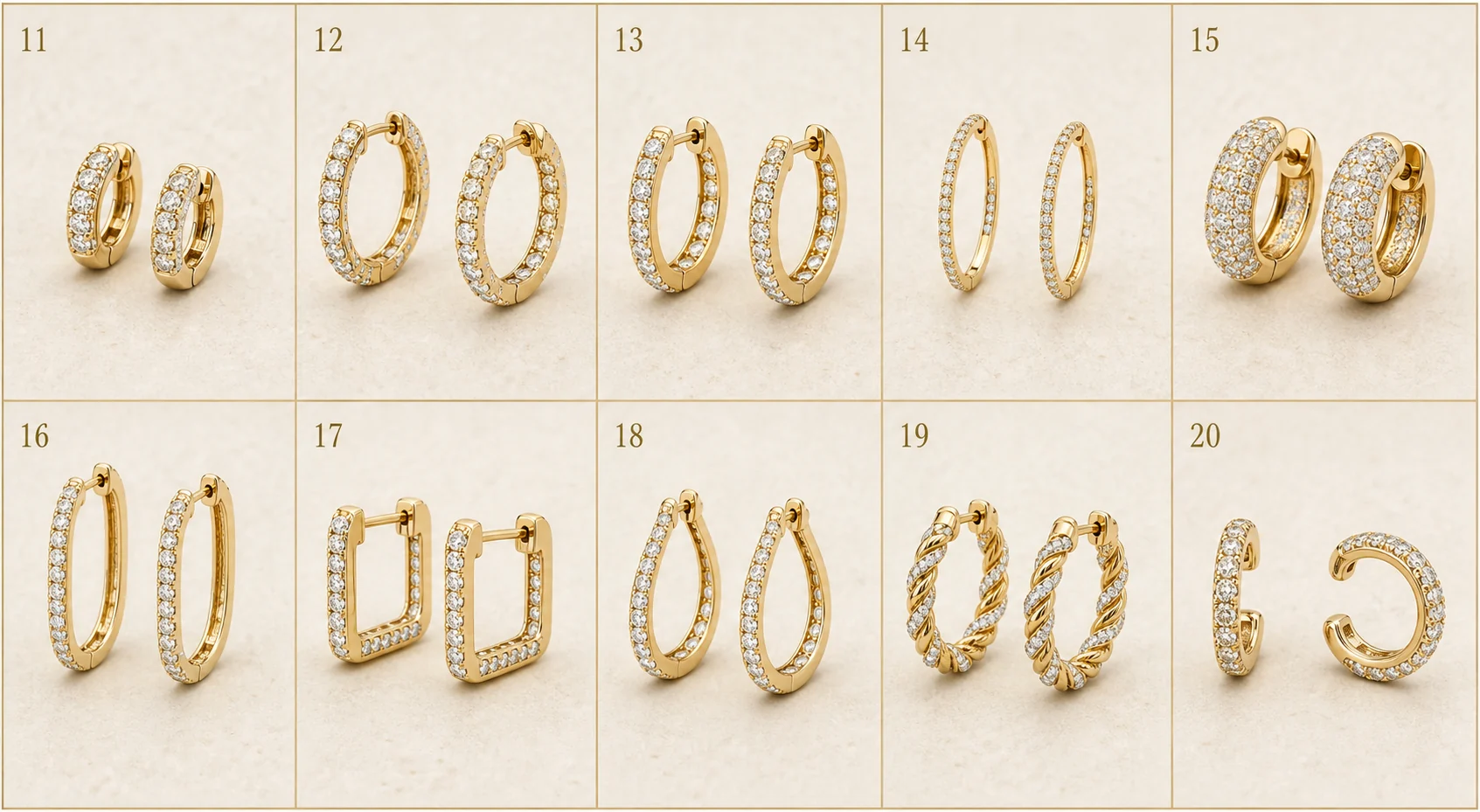
- 11Diamond huggie
- 12Classic diamond hoop
- 13Inside-out diamond hoop
- 14Thin diamond hoop
- 15Chunky pavé hoop
- 16Oval diamond hoop
- 17Square diamond hoop
- 18Teardrop diamond hoop
- 19Twisted diamond hoop
- 20Diamond ear cuff
Drops & statement styles
Vertical designs shaped by length, movement, articulation, and suspended elements.
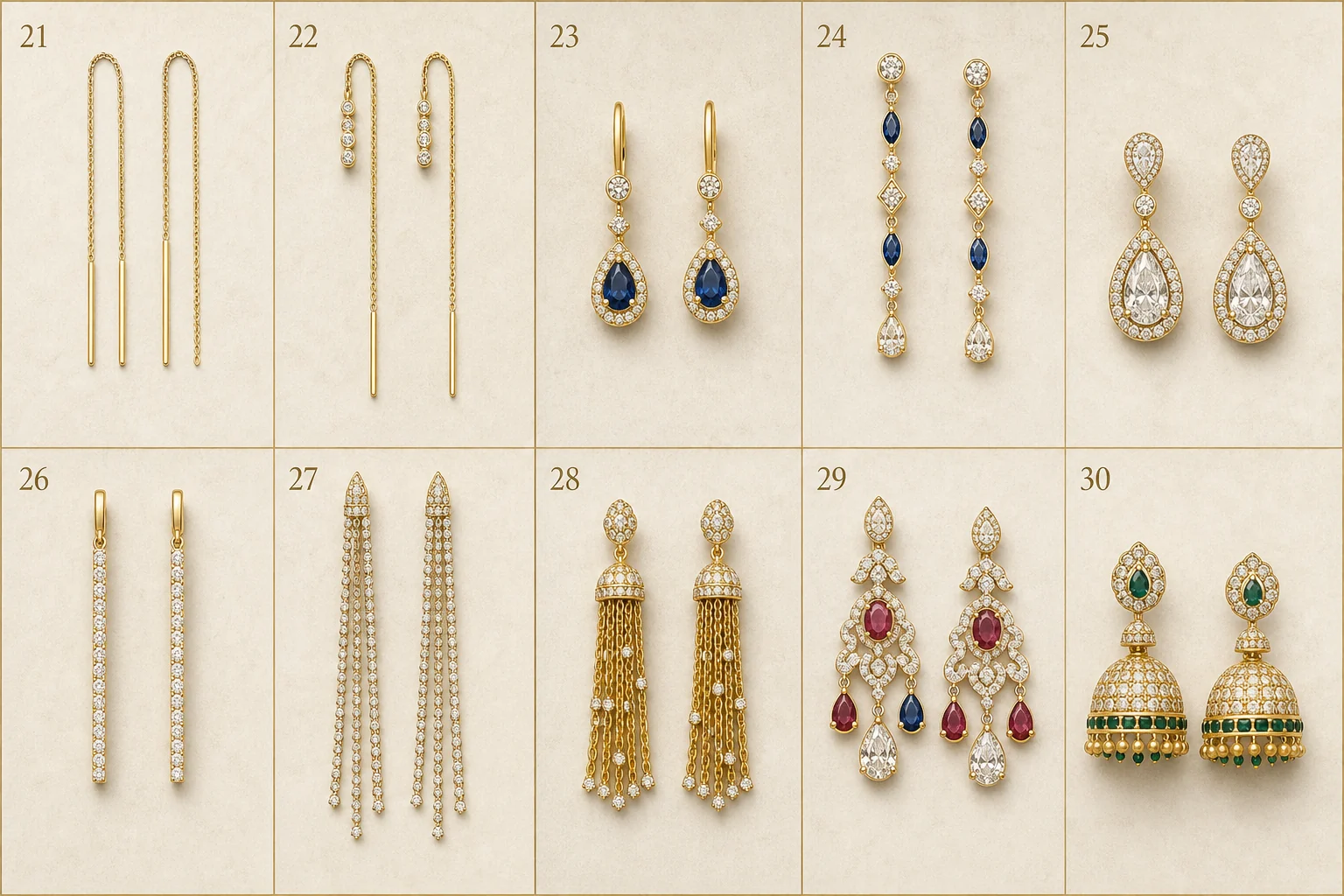
- 21Threader
- 22Pull-through
- 23Drop
- 24Dangle
- 25Teardrop
- 26Bar
- 27Chain
- 28Tassel
- 29Chandelier
- 30Jhumka
Recognizable silhouettes
Thirty styles
to compare.
A style establishes the direction. Scale, stones, metal, setting, movement, and closure determine how it becomes a production-ready design.
Gemstone stud
A single colored gemstone sits close to the lobe in a compact setting.
Diamond solitaire stud
One diamond is the complete visual focus, usually held by prongs or a bezel.
Ball stud
A polished metal sphere creates a clean, rounded close-to-the-ear silhouette.
Flower stud
Petal-like stones or metal elements form a floral motif against the lobe.
Pearl stud
A pearl is mounted directly to a post for a smooth, classic profile.
Halo stud
Smaller stones surround a center stone, adding brilliance and visual spread.
Ear jacket
A front stud pairs with a decorative component positioned behind the lobe.
Ear climber
A curved line of metal or stones rises upward along the earlobe.
Ear crawler
An elongated design sweeps horizontally or diagonally across the lobe.
Front-back stud
Visible elements sit on both sides of the lobe to create a dimensional profile.
Diamond huggie
A small hinged diamond hoop follows the earlobe closely with little open space.
Classic diamond hoop
A round diamond-set hoop creates an even circular silhouette around open space.
Inside-out diamond hoop
Diamonds face forward on the outer front and inner back surfaces for continuous sparkle.
Thin diamond hoop
A fine, lightweight hoop uses a narrow line of diamonds for a delicate appearance.
Chunky pavé hoop
A broad hoop surface is covered with closely set diamonds for greater visual weight.
Oval diamond hoop
An elongated diamond-set outline creates a narrower, longer profile than a round hoop.
Square diamond hoop
Straight sides and defined corners give the diamond hoop a geometric outline.
Teardrop diamond hoop
A hoop narrows toward one end to create a pear-shaped or teardrop silhouette.
Twisted diamond hoop
Intertwined metal and diamond lines create texture and a rope-like sense of movement.
Diamond ear cuff
An open diamond-set form wraps the outer ear and may be worn without a piercing.
Threader
A fine chain or slender wire passes through the piercing and hangs on both sides.
Pull-through
A chain is drawn through the piercing to create adjustable front and back lengths.
Drop
A stone or ornament hangs below a defined top element in a clear vertical line.
Dangle
Articulated elements extend below the lobe and move freely with the wearer.
Teardrop
A pear-shaped element defines the lower silhouette of the earring.
Bar
A straight vertical form creates a clean, narrow, architectural drop.
Chain
One or more flexible chains create length, movement, and a light visual line.
Tassel
Multiple fine chains or strands gather beneath a decorative top and move together.
Chandelier
A decorative upper section supports several articulated drops or tiers.
Jhumka
A traditional bell- or dome-shaped drop creates a broad, ornate lower profile.
Before choosing a style
Design for the ear
and the wearer.
The right structure should create the intended look while remaining secure, balanced, comfortable, and practical for its expected use.
Scale & placement
Diameter, length, and the piercing position determine how the design sits on the ear and frames the face.
Weight & support
Metal volume, stones, component thickness, and the selected back should keep the earring secure without unnecessary pulling.
Movement & clearance
Drops, dangles, chains, and hinged forms need enough space to move cleanly without tangling or contacting nearby elements.
Closure & daily wear
Posts, friction backs, screw backs, hinges, hooks, and other closures should suit the earring’s scale, value, and intended use.