
Closure reference
Jewelry chain
clasps.
Twenty distinct clasp mechanisms, constructions, applications, and decorative forms—from discreet spring closures to precision box clasps, pearl-strand fittings, and visible statement clasps.
Small component, important job
The closure is part of the design.
A clasp connects the ends of a necklace or bracelet while allowing the wearer to put it on and remove it. Its construction affects security, comfort, balance, appearance, and ease of use.
Names can describe different things. Some identify the mechanism, while others describe the clasp’s shape, appearance, or intended use. The guide keeps those distinctions visible instead of forcing every clasp into one naming system.
Visual reference
Twenty styles,
one guide.
Compare working mechanisms, specialty constructions, application-based forms, and decorative closures together. The descriptions below explain which type of distinction each name represents.
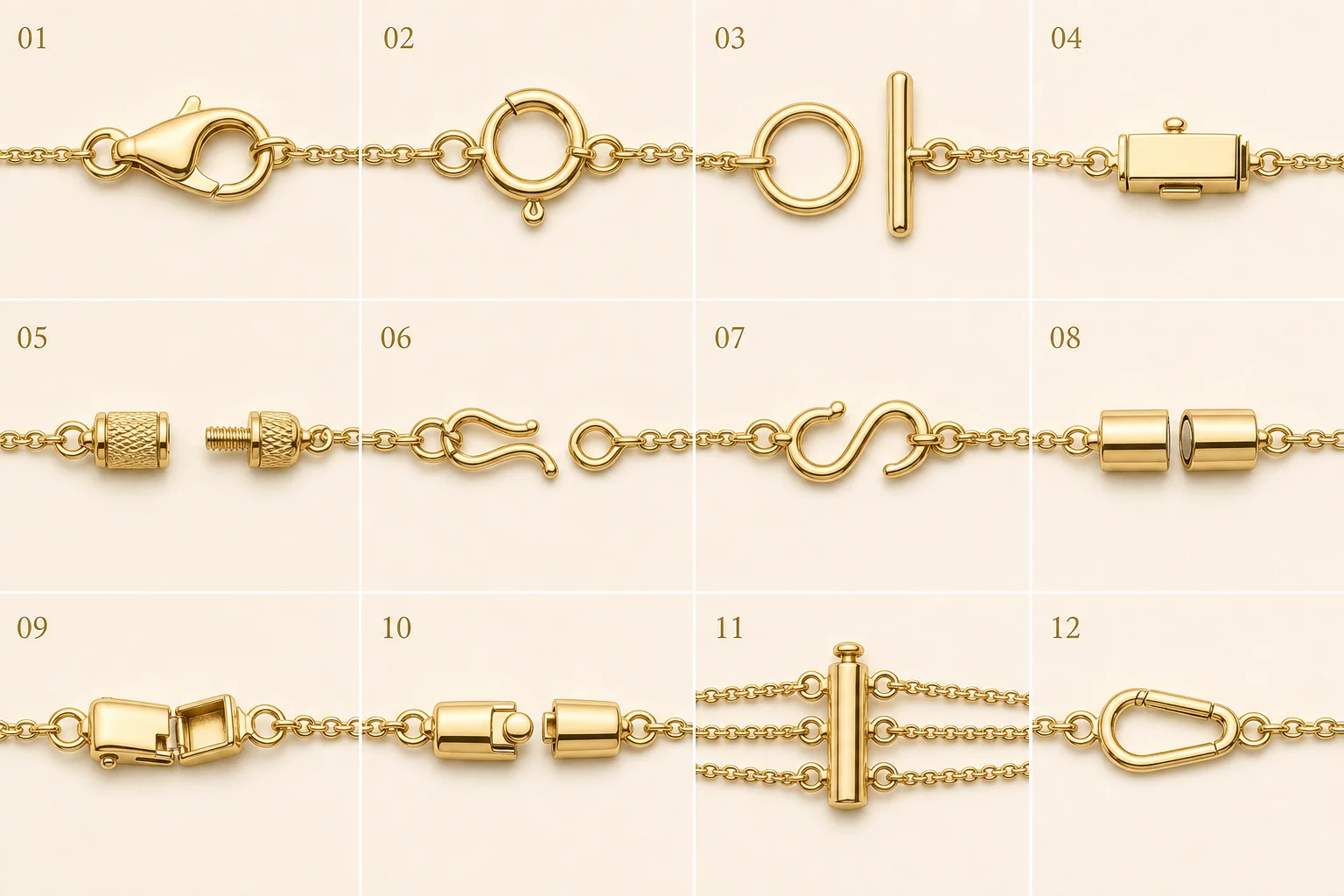
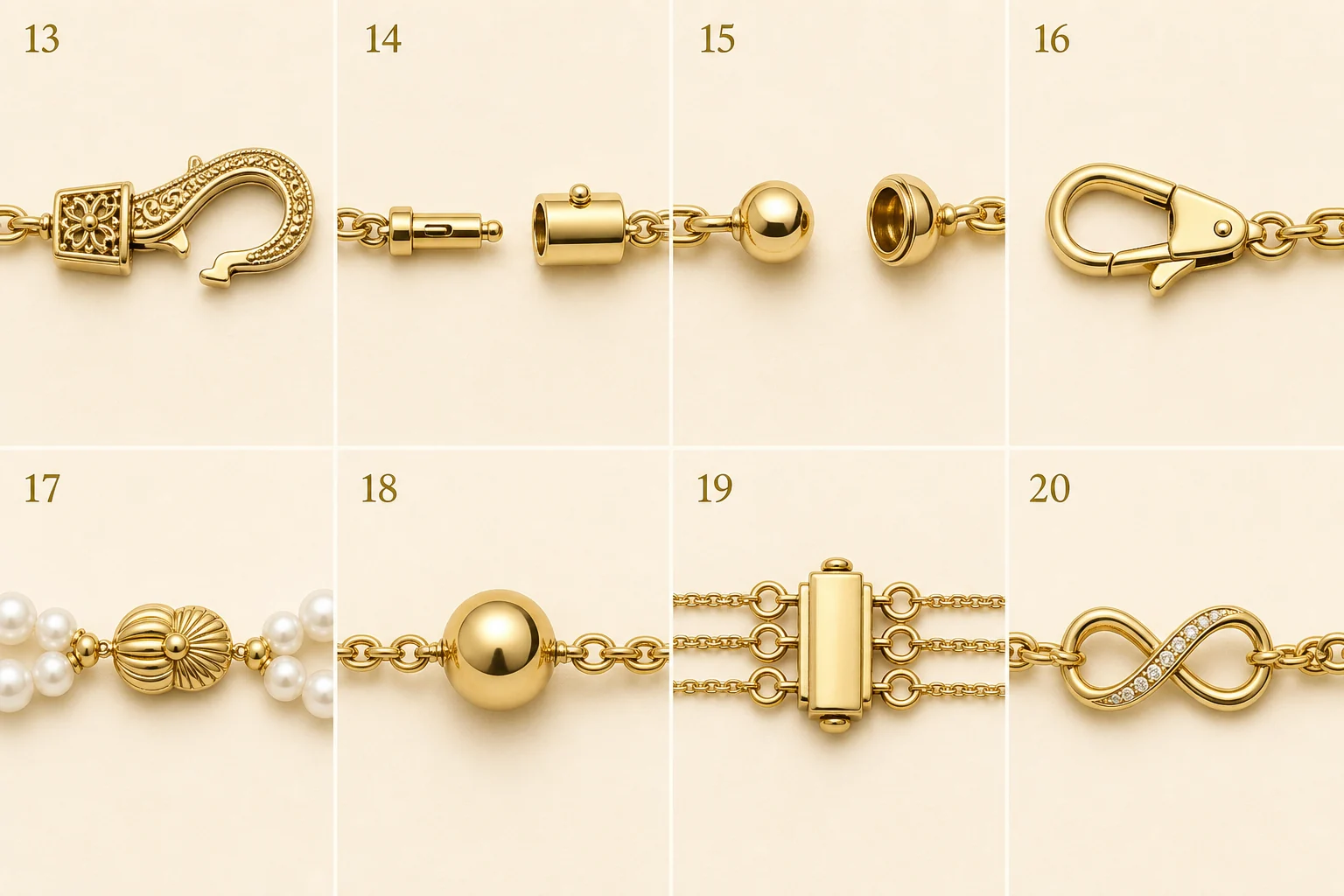
- 01Lobster clasp
- 02Spring-ring clasp
- 03Toggle clasp
- 04Box clasp
- 05Barrel or screw clasp
- 06Hook-and-eye clasp
- 07S-hook clasp
- 08Magnetic clasp
- 09Fold-over or snap clasp
- 10Push-button clasp
- 11Slide-lock clasp
- 12Carabiner clasp
- 13Fishhook or filigree clasp
- 14Bayonet clasp
- 15Ball-and-joint clasp
- 16Self-closing snap hook
- 17Pearl-strand clasp
- 18Bead-form clasp
- 19Multi-strand clasp
- 20Decorative motif clasp
How each one works
Twenty distinct
clasp concepts.
No single clasp is right for every piece. The jewelry type, chain construction, weight, value, scale, wearer, and intended appearance should be considered together.
Lobster clasp
A spring-loaded lever opens a hinged claw, which closes around a jump ring or chain tab when released. It is a widely used, compact closure for necklaces and bracelets.
Spring-ring clasp
A small trigger retracts part of a circular, spring-loaded ring. Its discreet scale suits many fine and lightweight chains, although a very small trigger can require more dexterity.
Toggle clasp
A T-shaped bar passes through a larger ring and turns across the opening. The bar, ring, chain length, and weight must work together so the closure remains seated during wear.
Box clasp
A flexible tab slides into a fitted box and catches inside it. Decorative versions can become part of the design, and selected constructions include a safety latch or safety chain.
Barrel or screw clasp
Two threaded halves twist together to form a low-profile barrel. It creates a clean line but normally requires both hands and careful alignment of the threads.
Hook-and-eye clasp
A shaped hook engages a ring or formed eye. It can be simple or decorative, with the hook proportions and the piece’s tension helping determine how securely it stays closed.
S-hook clasp
An S-shaped hook connects the end rings on both sides. One side may be closed permanently while the other is adjusted to provide the opening and the required holding tension.
Magnetic clasp
Magnets draw two fitted halves together, making the closure easy to operate. Magnet strength, piece weight, intended activity, and any added safety feature should be reviewed together.
Fold-over or snap clasp
A hinged section folds over a mating bar or frame and snaps into place. Its low profile and broad contact area make it a common option for bracelets and structured chains.
Push-button clasp
The two halves push together until an internal catch engages; a button releases the mechanism. Precision, positive engagement, and protection from accidental release are important.
Slide-lock clasp
One tube slides into another and locks in position. Multiple attachment loops keep two or more strands aligned, making this closure especially useful for multi-strand jewelry.
Carabiner clasp
A larger oval or geometric body uses a hinged or screw-style gate. Often designed to be visible, it can function as both a substantial closure and a focal component.
Fishhook or filigree clasp
A notched, fishhook-shaped tongue compresses as it enters a small decorative box and catches inside. This compact traditional mechanism is often used on fine chains and pearl jewelry.
Bayonet clasp
A shaped pin enters a fitted sleeve and locks with a push, twist, or internal catch. Its narrow profile can continue the line of a chain, cord, or bead strand.
Ball-and-joint clasp
A metal ball presses into a fitted socket and is held by controlled tension. The dimensions and holding force must suit the weight and movement of the complete piece.
Self-closing snap hook
A hinged gate opens under finger pressure and springs closed when released. Larger versions can function as a visible closure or as a connector for interchangeable components.
Pearl-strand clasp
A clasp proportioned and finished for pearl or bead strands. It may contain a fishhook, box, push, or other internal mechanism, so this name describes its specialized application rather than one mechanism.
Bead-form clasp
A rounded exterior blends into a necklace like another bead. The concealed closure may be magnetic, bayonet, tab, or push-operated; bead form describes its appearance rather than its internal mechanism.
Multi-strand clasp
Two or more attachment points keep parallel strands organized and distribute their load. The closing mechanism may be a box, slide lock, hook, toggle, or another suitable construction.
Decorative motif clasp
A recognizable form—such as an infinity motif—turns the closure into a focal detail. The visible shape still relies on an underlying hook, hinge, tab, magnet, or other working mechanism.
Choosing a clasp
Match the closure
to the complete piece.
The clasp should support how the jewelry looks, moves, feels, and is used—not simply connect two ends.
Weight & value
The mechanism, metal thickness, attachment rings, and any safety feature should be appropriate for the jewelry’s weight, value, and expected movement.
Ease of use
Trigger size, opening direction, hand strength, dexterity, and whether the piece is a necklace or bracelet all affect how comfortably the wearer can operate it.
Balance & appearance
A clasp can disappear into a fine chain, align several strands, or become a visible design feature. Its scale and weight should not pull the jewelry out of position.
Inspection & service
Springs, tabs, magnets, hinges, threads, soldered rings, and safety catches should remain accessible for inspection, cleaning, adjustment, and replacement.