
Style reference
Necklace
styles.
A practical visual guide to 24 necklace families—from pendants, stations, and stone lines to lariats, collars, bibs, layered strands, torques, and long sautoirs.
Start with the composition
Style describes the complete necklace.
A necklace style may be defined by its focal element, stone arrangement, silhouette, strand construction, worn length, or the way its parts move together.
Chain style describes the individual link pattern—such as cable, curb, Figaro, rope, box, or wheat chain. Those constructions deserve their own dedicated guide and are not mixed into this atlas.
Visual reference
Twenty-four styles,
one guide.
The continuous visual reference compares pendant-led, line, close-fitting, draped, strand, sculptural, and long-form necklace designs.
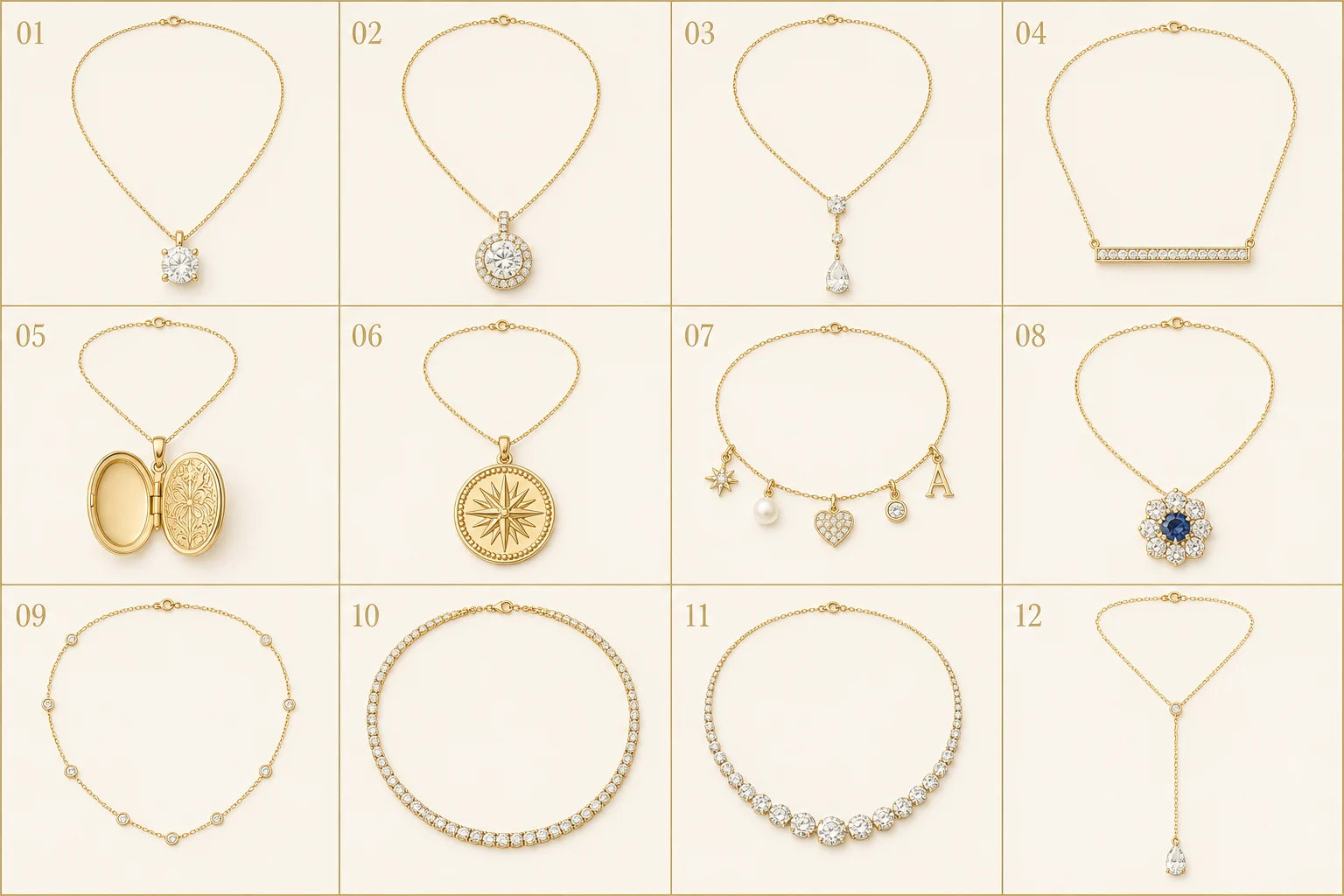
- 01Solitaire pendant
- 02Halo pendant
- 03Drop pendant
- 04Bar necklace
- 05Locket
- 06Medallion
- 07Charm necklace
- 08Cluster necklace
- 09Station necklace
- 10Tennis or line necklace
- 11Rivière
- 12Lariat or Y-necklace
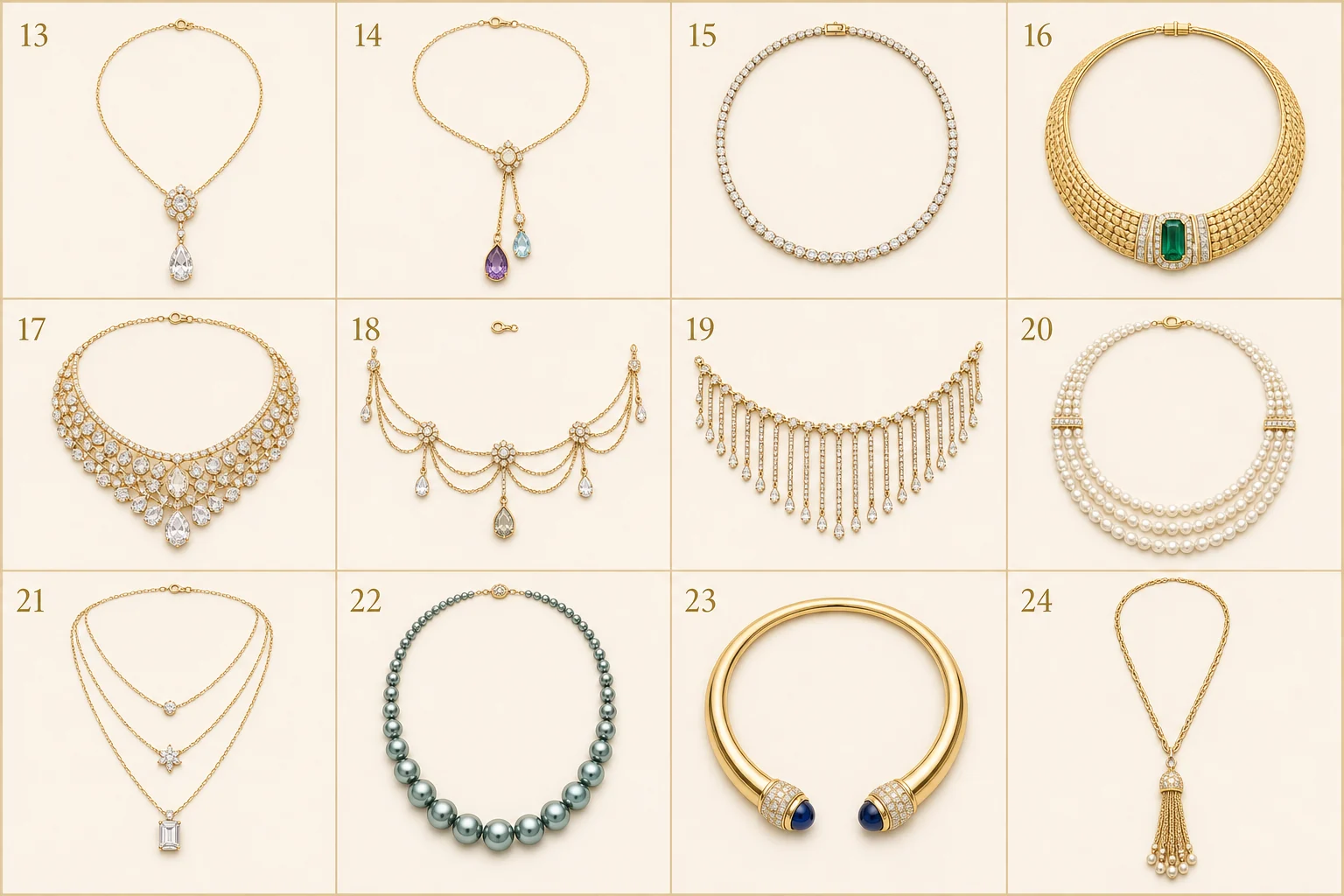
- 13Lavalier
- 14Négligée
- 15Choker
- 16Collar
- 17Bib necklace
- 18Festoon
- 19Fringe necklace
- 20Multi-strand
- 21Layered necklace
- 22Graduated strand
- 23Torque
- 24Sautoir or long rope
Recognizable designs
Twenty-four necklace styles
to know.
Names can overlap because one necklace may combine several ideas—for example, a layered design may include a station chain, locket, and solitaire pendant at different lengths.
Solitaire pendant
One featured diamond or gemstone hangs from a chain and carries the design. Bail, setting, chain weight, and pendant scale determine how it faces and moves.
Halo pendant
A border of smaller stones surrounds the featured center stone, increasing brightness and visual outline while keeping one central focal point.
Drop pendant
One or more elements extend vertically below the main connection. Articulation can add movement while the drop creates a longer visual line.
Bar necklace
A horizontal bar forms the focal point between two chain sections. The bar may be plain, engraved, curved, personalized, or stone-set.
Locket
A hinged or opening pendant contains space for a photograph, keepsake, or message. Closure security, hinge durability, and interior finishing are essential.
Medallion
A larger disc or plaque presents an emblem, relief, engraving, coin, stone arrangement, or decorative surface as the dominant focal element.
Charm necklace
Several small pendants or symbolic elements hang from one chain. Spacing, weight, attachment, and movement determine how the charms distribute.
Cluster necklace
Diamonds or gemstones gather into one floral, geometric, or organic focal composition that reads as a larger visual element.
Station necklace
Stones, bezels, beads, or motifs appear at measured intervals along a chain. Diamonds-by-the-yard is a familiar stone-set variation.
Tennis or line necklace
A continuous flexible line of individually set stones circles the neck. Articulation, matching, clasp security, and resistance to overturning are central.
Rivière
A continuous gemstone line graduates toward larger stones at the center, creating a stronger focal point than a uniformly sized line necklace.
Lariat or Y-necklace
A long vertical drop descends from a central junction, loop, or sliding element. Some lariats are open-ended, while Y-necklaces usually use a fixed closure.
Lavalier
A delicate central ornament suspends a single articulated drop beneath it. The style emphasizes a light, vertical composition rather than a large pendant.
Négligée
Two pendant drops of unequal length descend from one central element. Their deliberate asymmetry and independent movement define the style.
Choker
A close-fitting necklace sits high around the neck. Fit, flexibility, clasp placement, and comfortable movement are especially important.
Collar
A broad or structured necklace sits closely around the base of the neck. It may be rigid, hinged, linked, mesh-like, or built from articulated sections.
Bib necklace
A wide decorative front extends below the neckline in connected layers or sections, creating substantial coverage and a strong statement silhouette.
Festoon
Decorative stations support multiple draped chains or gemstone swags. The spacing and graduated curves create a garland-like composition.
Fringe necklace
Repeated vertical drops hang from a supporting chain or collar. Graduation, articulation, and controlled movement shape the finished outline.
Multi-strand
Two or more coordinated strands form one necklace and join through shared ends or a multi-strand clasp. Strand spacing and length prevent tangling.
Layered necklace
Separate chains or components sit at different lengths to create a planned tiered composition. Focal placement and spacing preserve the layers.
Graduated strand
Pearls, beads, or gemstones increase in size toward the center. Careful matching and controlled graduation create balance across the neckline.
Torque
A rigid or semi-rigid open metal form curves around the neck and usually finishes with defined end caps, stones, or sculptural terminals.
Sautoir or long rope
An elongated necklace falls well below the chest and may finish with a pendant or tassel. It can be worn long, doubled, or wrapped when construction allows.
Before choosing a style
Design for the neckline
and natural movement.
The right necklace should create the intended silhouette while remaining balanced, comfortable, secure, and serviceable.
Length & neckline
The worn length, focal depth, and neckline should be considered together so the necklace sits where the design is intended to be seen.
Weight & balance
Pendant weight, chain gauge, stone distribution, and back-chain balance determine whether the necklace stays centered and comfortable.
Movement & articulation
Links, stations, hinges, drops, and stone settings need enough movement to follow the body without twisting, binding, or overturning.
Clasp & service
Closure security, end connections, cleaning access, stone inspection, refinishing, and future repairs should be planned before production.