
Setting reference
Jewelry setting
styles.
Eight widely used ways to secure and present stones—each with a different balance of visibility, protection, surface detail, engineering, and care.

Start with the function
A setting holds the stone.
A setting is the metal structure or technique that secures a diamond or gemstone in a piece of jewelry. It also affects the design’s silhouette, stone visibility, protection, cleaning access, and future service.
Setting and style are related but not interchangeable. For example, a solitaire describes the overall ring style; its center stone may be held by prongs or a bezel.
Visual comparison
Eight settings,
side by side.
The image focuses on the metal and structure that secure the stones—from exposed prongs and bars to continuous channels, flush metal, and concealed invisible-setting rails.
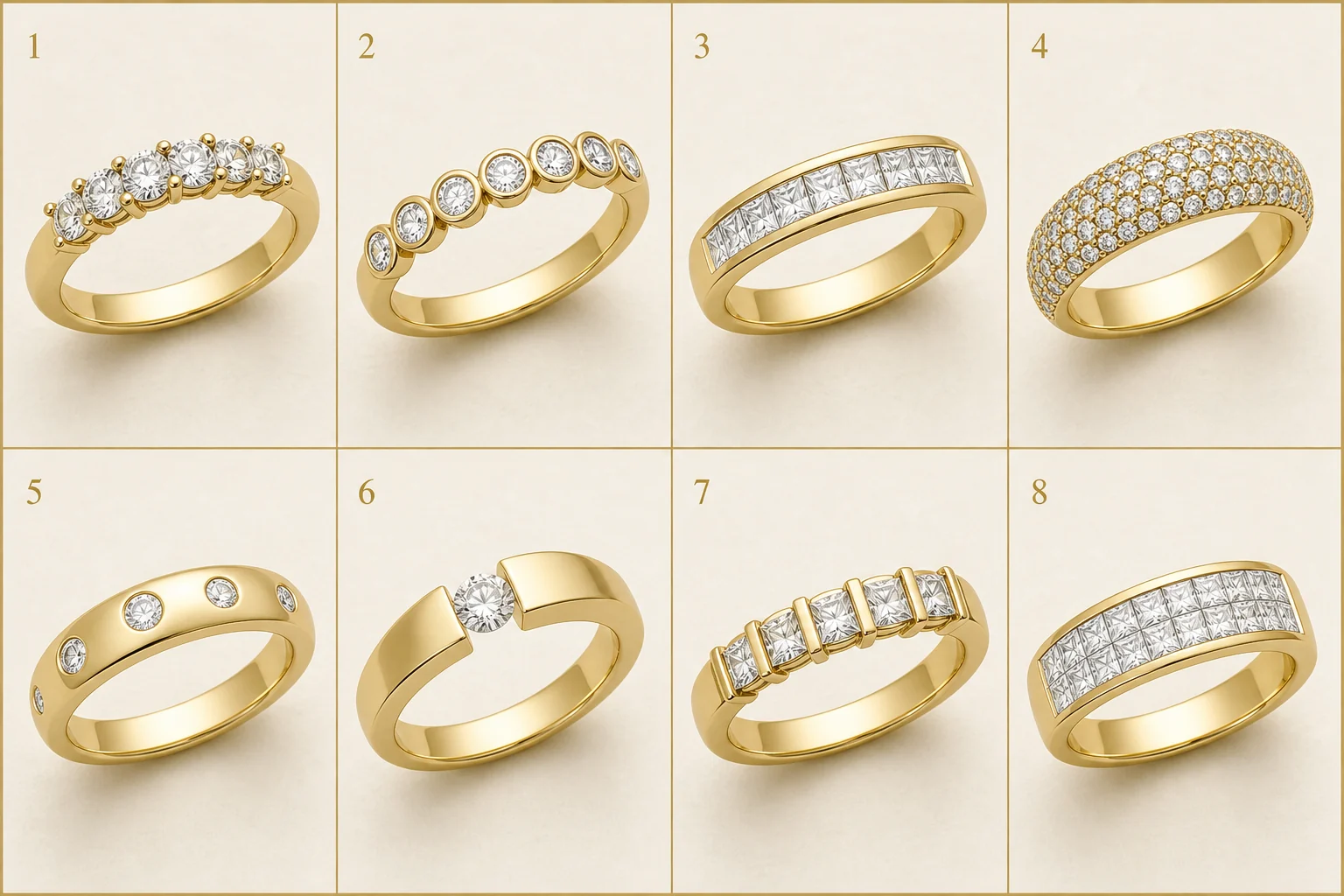
- 01Prong setting
- 02Bezel setting
- 03Channel setting
- 04Pavé setting
- 05Flush or gypsy setting
- 06Tension-style setting
- 07Bar setting
- 08Invisible setting
How each one works
Different ways
to secure a stone.
No single method is automatically best. The right choice depends on the stone, jewelry type, intended appearance, wear pattern, construction, and maintenance expectations.
Prong setting
Narrow metal supports—often called prongs or claws—rise around a stone and bend over its edge to hold it in place. Four- and six-prong arrangements are common for center stones.
Bezel setting
A fitted rim of metal surrounds all or part of a stone’s edge. A full bezel creates a smooth protective outline; a partial bezel leaves selected sides more exposed.
Channel setting
A row of stones is secured between two continuous, opposing metal walls. The stones sit edge-to-edge without individual prongs, creating a smooth linear appearance.
Pavé setting
Small stones are placed closely across a metal surface and secured with tiny raised beads or prongs. The result is a field of sparkle with very little visible metal between stones.
Flush or gypsy setting
A stone is set directly into the metal so its top sits close to or level with the surrounding surface. Metal is worked around the stone to secure it without a raised rim or prongs.
Tension-style setting
A center stone appears suspended between two opposing sides of the ring. True tension settings require precise engineering; tension-look designs may use hidden structural support.
Bar setting
Stones are secured between vertical metal bars. Their sides remain more exposed than in a channel, allowing the individual stone shapes and spaces between them to remain visible.
Invisible setting
Grooved square or rectangular stones fit onto a concealed metal framework beneath their edges. From above, the stones meet in a continuous surface with no visible prongs between them.
Choosing a setting
Balance appearance
with daily wear.
Stone dimensions, metal thickness, profile, exposure, and the wearer’s routine should be reviewed together before the setting is finalized.
Stone exposure & appearance
Prong, tension-style, and bar settings expose more of a stone. Bezel, channel, and flush settings create stronger metal outlines, while pavé and invisible settings build broader stone surfaces.
Protection & profile
Bezels, channels, and flush settings can provide smoother, more protected profiles. Exposed corners, raised stones, narrow bars, and delicate pavé beads require design-specific review.
Stone & construction requirements
Stone dimensions, girdles, cuts, matching, metal thickness, and production tolerances determine which settings are practical. Tension and invisible settings require especially precise engineering.
Cleaning, inspection & repair
Every setting should be inspected for wear, movement, impact, and buildup. Future stone replacement, refinishing, resizing, and access beneath the stones should be considered before approval.