
Style reference
Ring
styles.
A broader guide to 32 ring-style families customers commonly recognize—from classic center-stone designs to bands, sculptural forms, purpose-led styles, and rings whose appearance is defined by the setting.
Start with the terminology
Style describes the whole ring.
A ring style describes the complete visual concept: the number and arrangement of featured stones, the relationship between the head and band, and the overall silhouette.
A setting describes how a stone is secured—such as prong, bezel, pavé, channel, or flush setting. One ring style can use several setting techniques.
Visual reference
Thirty-two styles,
one guide.
The continuous visual reference includes classic designs, band and construction styles, purpose-led rings, and setting-led designs whose stone-holding method defines the overall look.
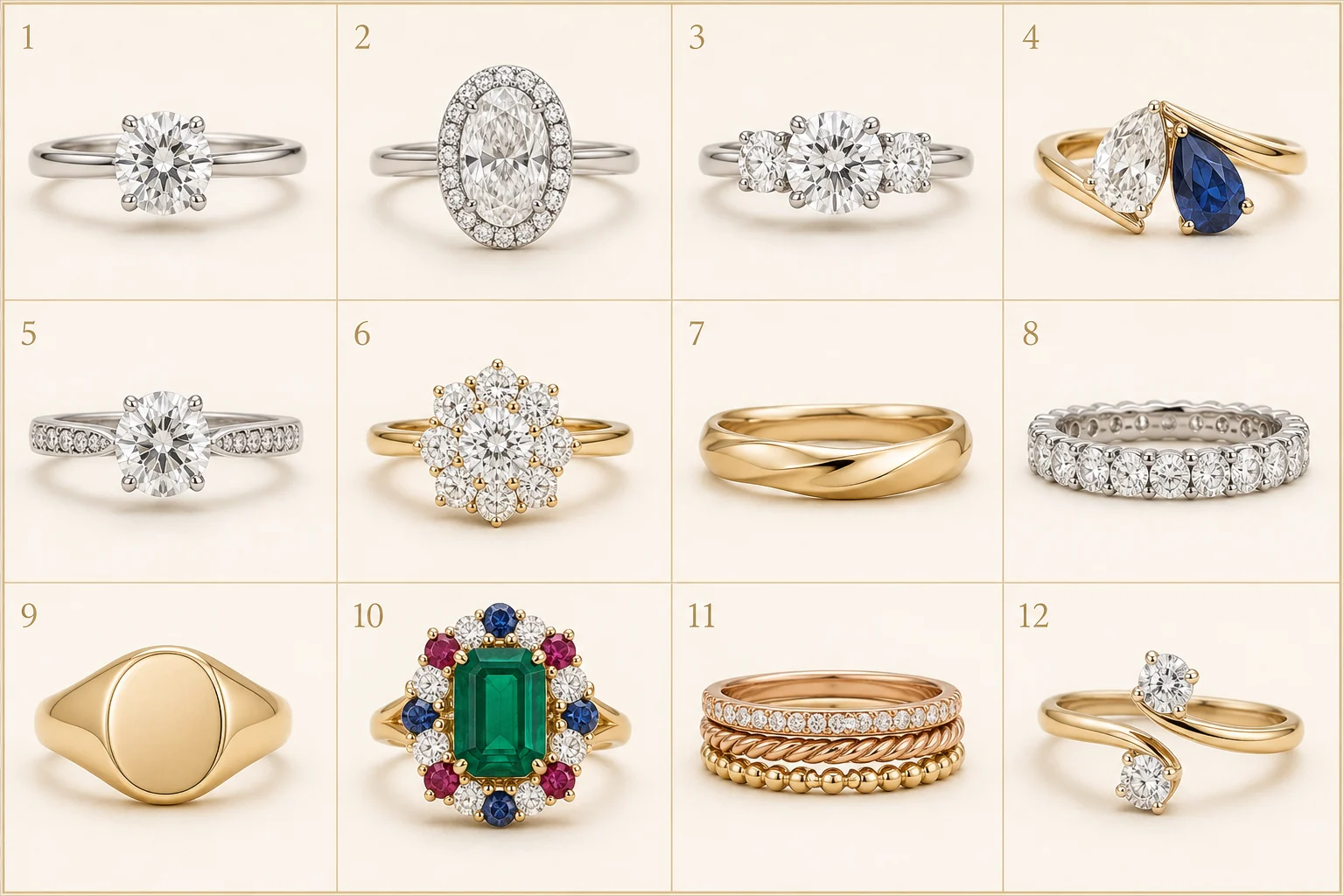
- 01Solitaire
- 02Halo
- 03Three-stone
- 04Toi-et-Moi
- 05Side-stone
- 06Cluster
- 07Band
- 08Eternity
- 09Signet
- 10Cocktail
- 11Stacking
- 12Bypass
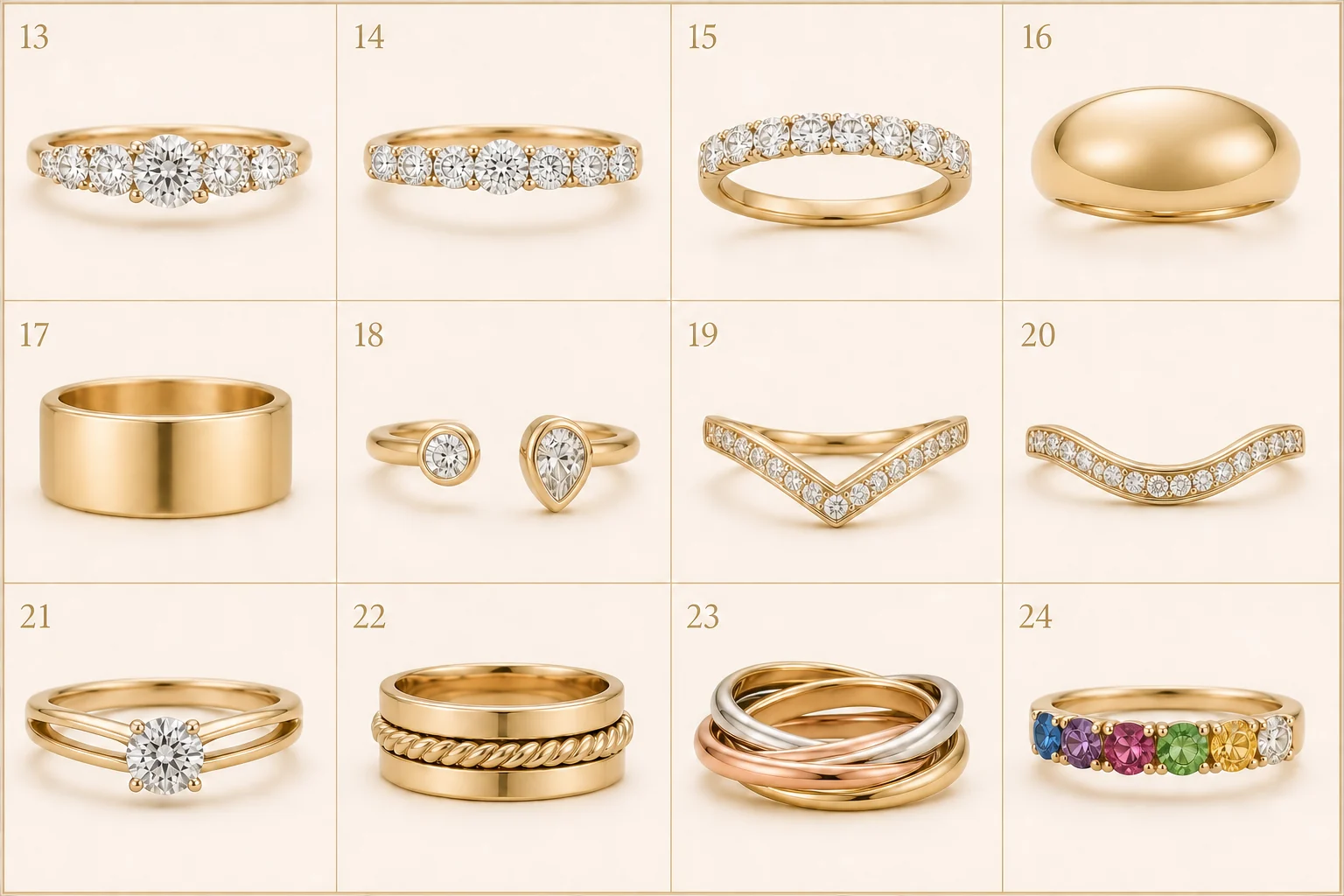
- 13Five-stone
- 14Seven-stone
- 15Half-eternity
- 16Dome
- 17Cigar band
- 18Open ring
- 19Chevron or V-shaped
- 20Contour or curved
- 21Split-shank
- 22Spinner
- 23Interlocking or puzzle
- 24Birthstone or family
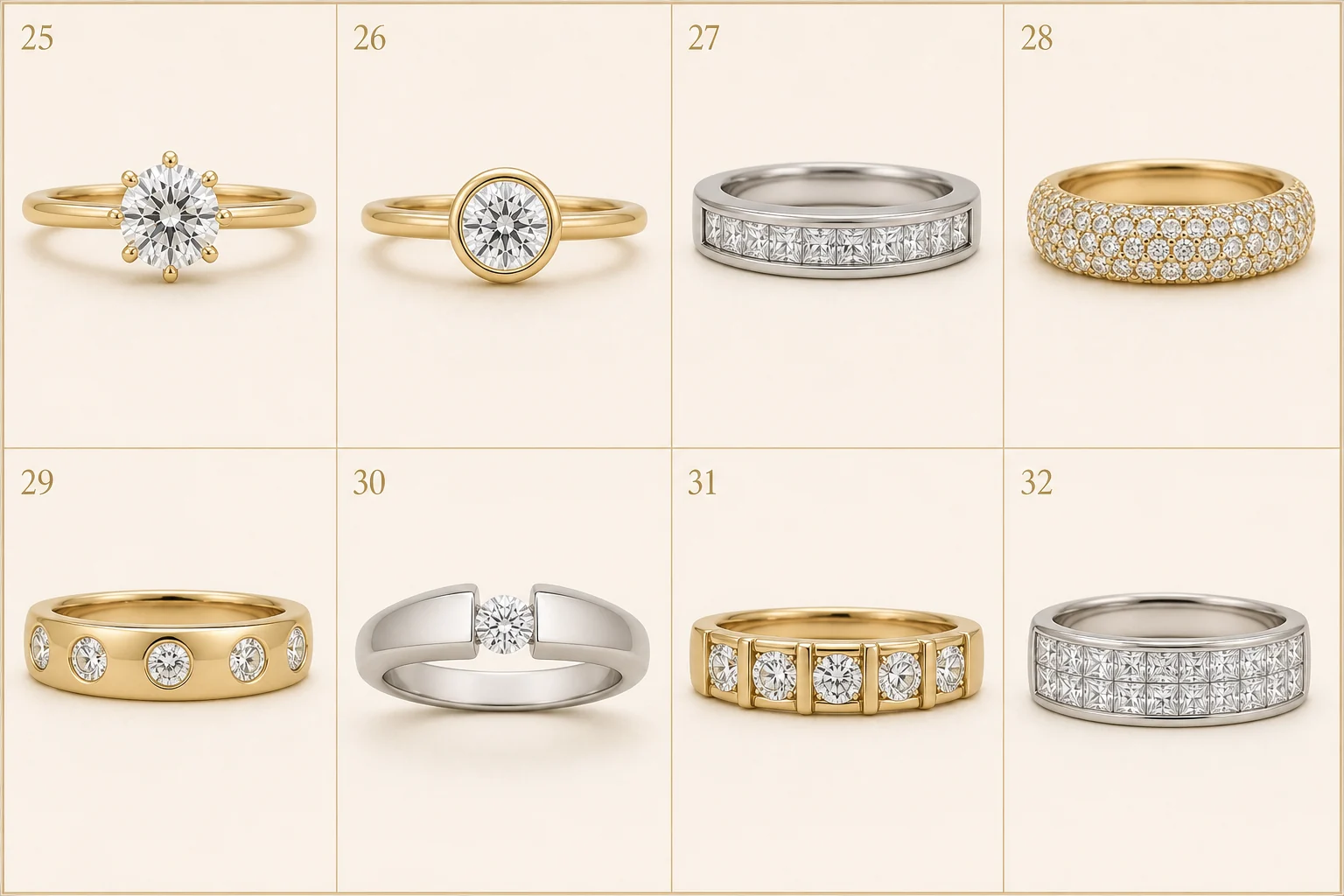
- 25Prong-set
- 26Bezel-set
- 27Channel-set
- 28Pavé-set
- 29Flush-set
- 30Tension-style
- 31Bar-set
- 32Invisible-set
Recognizable designs
Thirty-two ring styles
to know.
These names provide a useful starting point, but real designs often combine more than one category. A ring may simultaneously be a halo, split-shank, and pavé-set design.
Solitaire
One featured center stone carries the design. The band may be plain or detailed, but the eye remains focused on a single stone.
Halo
A border of smaller stones surrounds the center stone, adding brightness and a larger visual outline. Halos may be round, shaped, hidden, or double.
Three-stone
A center stone is balanced by one stone on each side. Side stones can match the center shape or create contrast through different cuts.
Toi-et-Moi
Two featured stones meet across an open or gently curved design. The stones may differ in shape, color, size, or type.
Side-stone
A featured center is supported by accent stones along the shoulders. The accents may taper, graduate, or continue partway around the band.
Cluster
Several stones are grouped to create one larger visual composition. Clusters may be symmetrical, floral, geometric, or organically arranged.
Band
A ring without one dominant center stone. Bands may be plain, textured, engraved, sculpted, or set with stones across part of the circumference.
Eternity
Stones continue around the full circumference of the ring. A half- or three-quarter-eternity variation can offer a similar look with easier sizing.
Signet
A broad face forms the visual center of the ring. It may be plain, engraved, monogrammed, stone-set, or shaped into a distinctive emblem.
Cocktail
A bold statement ring built around scale, color, or an expressive composition. Comfort, height, stone protection, and balance become especially important.
Stacking
Slim rings are designed to be combined in different arrangements. Width, profile, stone height, and edge details determine how comfortably they sit together.
Bypass
The two sides of the shank curve past one another rather than meeting in a straight line. The ends may hold stones or form a sculptural focal point.
Five-stone
Five featured stones extend across the top of the finger. They may match in size or graduate toward a larger center stone.
Seven-stone
Seven stones create a broader line of coverage across the finger. Matching, graduation, spacing, and flexibility influence the finished balance.
Half-eternity
Stones cover the upper portion of the band while the lower shank remains plain. It provides an eternity-style appearance with more room for sizing and service.
Dome
A smooth convex surface rises above the finger to create a rounded, sculptural profile. The dome may be polished, textured, engraved, or stone-set.
Cigar band
A broad band maintains substantial width around the finger. Edge shape, inside profile, thickness, and taper determine comfort and visual weight.
Open ring
A controlled gap separates the two ends of the ring. The ends may remain minimal or carry stones, motifs, initials, or sculptural details.
Chevron or V-shaped
The band forms a defined point at the center. It can be worn alone, stacked, or shaped to frame another ring.
Contour or curved
A gentle arc or custom outline follows the profile of another ring. The curve can accommodate a center setting, halo, or projecting detail.
Split-shank
The shank divides into two or more visible branches as it approaches the top of the ring. The opening adds width and changes how the center is visually supported.
Spinner
One or more outer bands move around a wider supporting band. Clearance, edge finishing, and controlled movement are central to the construction.
Interlocking or puzzle
Two or more shaped bands connect, weave, or fit together to create one composition. The parts may be permanently linked or designed to separate.
Birthstone or family
Selected gemstones represent a person, month, or family group. The design may use one stone or coordinate several colors, shapes, and sizes.
Prong-set
Visible metal prongs rise around the featured stone and bend over its edge. The exposed stone and recognizable claw structure strongly influence the ring’s finished appearance.
Bezel-set
A fitted metal rim surrounds all or part of the featured stone. The smooth outline creates a visually distinct ring with a protective, contemporary profile.
Channel-set
A row of stones sits between two continuous metal walls without individual prongs. The construction creates a smooth, uninterrupted line across the band.
Pavé-set
Many small stones sit closely across the ring’s surface and are secured with tiny beads or prongs. The broad field of sparkle becomes the defining visual feature.
Flush-set
Stones are seated directly into the metal so their tops sit close to the surrounding surface. The result is a low-profile ring with clean, scattered points of light.
Tension-style
A featured stone appears suspended between two opposing ends of the shank. The open space and engineered metal structure define the ring’s silhouette.
Bar-set
Individual stones are separated and secured by visible vertical metal bars. The repeated bars and exposed stone sides create a recognizable architectural rhythm.
Invisible-set
Square or rectangular stones meet across a concealed supporting structure with no visible prongs between them. The result appears as one continuous gemstone surface.
Before choosing a style
The best design
must also work.
Appearance begins the conversation. Proportion, wearability, construction, and future service turn the idea into a successful finished ring.
The center stones
Stone shape, dimensions, depth, and quantity influence which proportions and structures will work.
How it will be worn
Daily wear, occasional wear, work habits, and preferred profile all affect durability and comfort.
How rings sit together
Engagement rings, wedding bands, and stacking rings should be planned together when a close fit matters.
Future service
Sizing access, stone replacement, cleaning, refinishing, and repair should be considered before production.