
Sizing reference
Ring widths
& fit.
Band width changes visual presence, finger coverage, and how a given ring size feels. The intended width and inside profile should be part of the sizing conversation.
Start with the measurement
Width is measured edge to edge.
Ring width is the distance across the band from one outer edge to the other, expressed in millimeters. It is different from metal thickness, which describes how deep the band is from its inside surface to its outside surface.
Two rings can have the same finger size and still feel different because of their width, inside contour, stone setting, shape, and the amount of metal touching the finger.
Proportional reference
See the width
on the rings.
Every example uses the same plain-band design and viewing angle. The visible band surface becomes progressively wider from 1.5 mm to 8 mm.
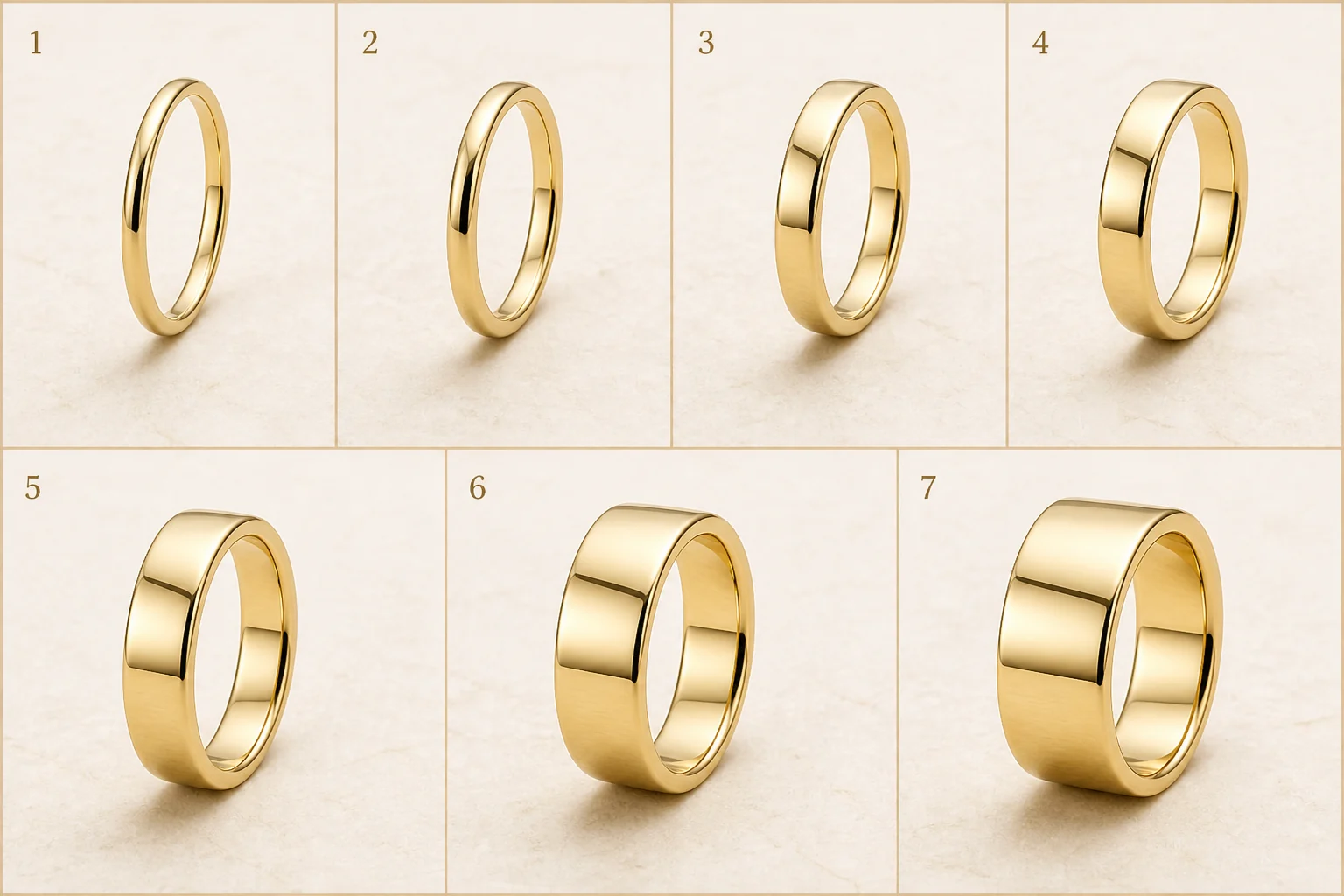
- 011.5 mm
- 022 mm
- 033 mm
- 044 mm
- 055 mm
- 066 mm
- 078 mm
How width changes the look
A practical visual
starting point.
Width labels describe appearance, not a universal construction rule. The appropriate dimensions depend on the design, material, stones, finger size, production method, and expected wear.
1.5–2 mm · Delicate
A fine visual line with minimal finger coverage. The design, metal, stone setting, and intended wear still determine how slender the finished shank can safely be.
2.5–3 mm · Balanced
A versatile middle range that can feel refined without disappearing visually. It works across many engagement rings, wedding bands, and everyday designs.
4–5 mm · Substantial
More visible metal and finger coverage create a stronger presence. Width should be tested during sizing because the band may feel closer than a narrow sample ring.
6–8 mm · Broad
A bold proportion often used for wide wedding bands and statement rings. The finished width and inside profile should be represented when confirming the size.
Inside profile
Width is only
part of the fit.
The contour inside the ring changes how much metal contacts the finger. Use the intended profile—not just the nominal size—when evaluating a finished design.
Standard interior
A relatively flat inside surface provides broad contact with the finger. Its edges and finished width influence how close the band feels.
Comfort-fit interior
A gently rounded interior reduces contact near the edges and can make a broad band easier to move over the knuckle and wear for long periods.
Tapered or variable width
A ring may be broader at the top and narrower underneath. Size is evaluated at the point where the ring actually meets the sizing tool and finger.
Confirming the fit
Size for the ring
being made.
A measurement is most useful when the sizing sample represents the finished ring’s width and inside profile, especially for broad bands and stacked rings.
Measure for the finished width
A narrow sizing ring may not predict how a broad band will feel. Rings wider than 4 mm should be checked with an appropriately wide sizing gauge or sample.
Check the knuckle and resting position
The ring should pass over the knuckle without being forced, then settle where it will be worn without turning freely or compressing the finger.
Consider the inside profile
A flat interior and a rounded comfort-fit interior contact the finger differently. Confirm size using a sample that represents the intended width and profile.
Plan the complete stack
An engagement ring and wedding band can feel wider and tighter together than either ring alone. Confirm the combined width when the pieces will usually be stacked.