
Ring construction reference
Solitaire ring
head styles.
A side-profile guide to the structures that hold and present one featured center stone—from open baskets and crown heads to bezels and low-profile designs.
Start with the structure
The head holds the center stone.
The head is the part of a ring mounting that supports and secures the featured diamond or gemstone. It may be built into the shank or attached as a separate component.
Head names can vary between designers and suppliers. The useful comparison is the actual architecture: prong count, gallery, height, shoulder support, stone exposure, and how the head connects to the shank.
Side-profile reference
Eight heads,
one view.
The side profile reveals how the prongs, gallery, shoulders, and shank work together beneath the center stone.
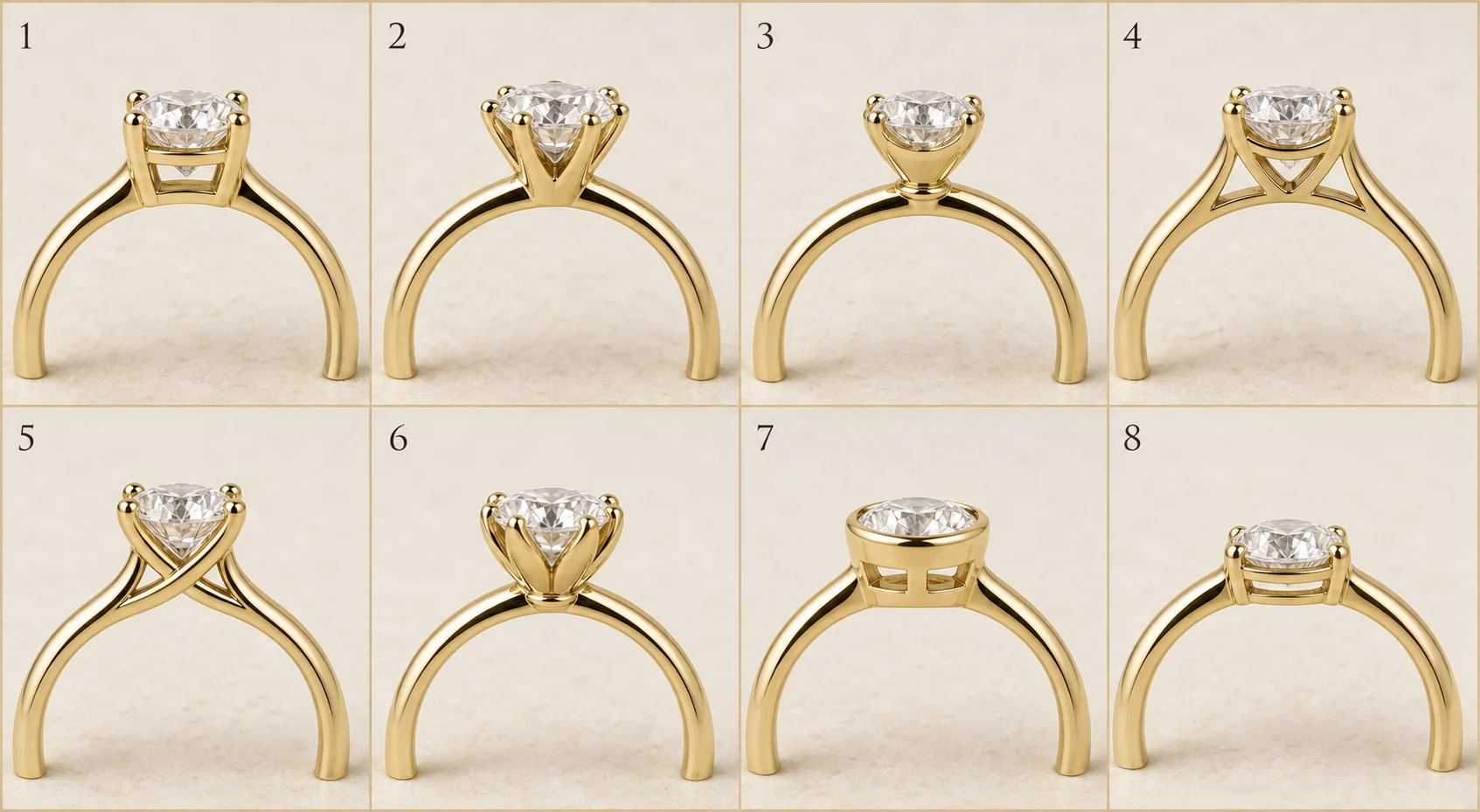
- 01Four-prong basket
- 02Six-prong crown
- 03Peg head
- 04Cathedral-supported
- 05Trellis
- 06Tulip
- 07Bezel head
- 08Low-profile basket
Recognizable structures
Eight head styles
to compare.
These categories often overlap. A cathedral ring, for example, may support a four-prong basket or a six-prong crown.
Four-prong basket
Four prongs rise from an open basket with a gallery rail beneath the stone. The structure shows more of the center stone and leaves useful access for cleaning.
Six-prong crown
Six evenly spaced prongs create a crown-like outline around a round center stone. The additional prongs provide more points of contact and emphasize a rounded silhouette.
Peg head
A separate compact head attaches to the shank at a narrow base or peg. It can make it easier to pair a mounting with a selected stone shape and size.
Cathedral-supported
The shank shoulders sweep upward to meet and visually support the center head. This can elevate the stone and influence how a wedding band fits beside the ring.
Trellis
Interwoven prongs cross beneath the stone, creating an open X-shaped side profile. The structure becomes a visible part of the ring’s design.
Tulip
Petal-like supports curve upward around the center stone. The head combines a floral side profile with an open gallery.
Bezel head
A continuous or nearly continuous rim surrounds the stone’s edge instead of using exposed prong tips. It creates a smooth outline and more edge protection.
Low-profile basket
A shallow basket seats the stone closer to the shank. The reduced height can lessen snagging, but stone depth and wedding-band clearance must still be planned.
Before selecting a head
Match the structure
to the complete ring.
The best choice balances the stone, desired profile, security, wedding-band relationship, and future care.
Stone shape & dimensions
The head must match the stone’s outline, girdle dimensions, and depth—not only its nominal carat weight.
Height & wedding-band fit
A raised head may leave room for a straight wedding band. A lower head may require a contoured band or a planned gap.
Security & daily wear
Prong count, protected stone points, profile, and the wearer’s routine all influence the appropriate structure.
Cleaning & future service
Access beneath the stone, prong inspection, refinishing, and possible head repair or replacement should be considered before approval.